


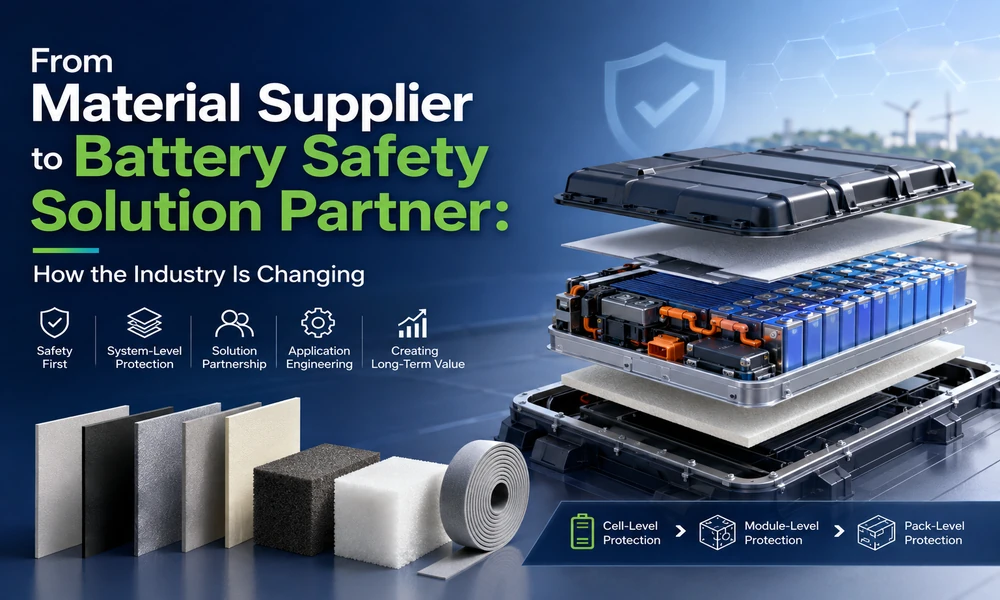
The rapid expansion of electric vehicles (EVs), battery energy storage systems (BESS), and high-energy-density lithium-ion batteries is changing not only the battery industry itself but also the role of companies supplying battery safety materials.
In the past, many material manufacturers operated primarily as component suppliers. Their responsibility was relatively straightforward: provide insulation sheets, foams, thermal barriers, or flame-retardant materials according to customer specifications.
Today, this model is evolving.
Battery manufacturers and energy storage system integrators increasingly expect suppliers to understand thermal runaway, electrical insulation, mechanical compression, fire protection, and system-level safety requirements. As a result, competitive suppliers are moving beyond selling individual materials and becoming lithium battery safety protection solution partners.
This transition is creating a new competitive landscape for the battery safety materials market.
1. Battery Safety Is Becoming a System-Level Challenge
Modern battery packs are becoming more complex.
Higher energy density allows EVs to travel farther and energy storage systems to store more electricity within a smaller footprint. However, concentrating more energy into a limited space also increases the consequences of thermal runaway.
A battery safety problem rarely involves only one material.
When a cell experiences abnormal heating, the safety system may need to simultaneously address:
- Electrical isolation between conductive components
- Heat transfer between neighboring cells
- Flame and high-temperature gas propagation
- Mechanical expansion and compression
- Thermal insulation between modules
- Protection of the battery pack enclosure
This means battery safety must increasingly be considered at the cell, module, and pack levels.
For material suppliers, the implication is significant: customers are no longer evaluating only whether a single material has a good thermal conductivity value, flame-retardant rating, or dielectric strength. They are asking how different materials work together inside the complete battery system.
2. From Selling Materials to Solving Specific Safety Problems
The traditional material supplier model is largely specification-driven.
A customer might request a flame-retardant insulation sheet of a certain thickness, density, dielectric strength, and temperature resistance. The supplier manufactures the material and delivers it according to the specification.
The emerging solution-partner model begins with a different question:
What safety problem does this material need to solve?
For example, PC insulation flame-retardant sheets can provide electrical insulation and flame-retardant protection around cells and electrical components. CR foam can provide cushioning, sealing, vibration absorption, and structural protection at the module level.
Nano silica composite thermal insulation boards can be used as thermal barriers to reduce heat transfer, while ceramifiable silicone foam can provide additional protection when exposed to extreme temperatures. At the pack level, PIR thermal insulation cushioning boards can combine thermal management with mechanical protection.
Instead of treating these as unrelated products, a battery safety solution partner considers them as different parts of a multi-layer protection strategy.
This changes the commercial conversation from:
“Which material do you need?”
to:
“Where is the safety risk, and what combination of materials can help manage it?”
That difference is becoming increasingly important.
3. Cell-Level, Module-Level and Pack-Level Protection Are Converging
One of the most important changes in the battery safety materials market is the growing integration of protection across multiple structural levels.
At the cell level, material selection may focus heavily on electrical insulation, flame retardancy, dimensional stability, and preventing localized faults from affecting surrounding components.
At the module level, the challenge becomes more complex. Materials may need to provide thermal insulation while accommodating cell expansion, mechanical vibration, compression, and manufacturing tolerances.
At the pack level, suppliers must consider larger thermal propagation paths, enclosure protection, structural cushioning, fire resistance, and the interaction between different battery modules.
This creates an important business opportunity.
A supplier capable of providing materials across all three levels can participate earlier in customer projects and potentially supply a larger share of the battery safety material system.
Instead of competing for one component, suppliers can compete for a solution platform.
4. Application Engineering Is Becoming a Competitive Advantage
As battery safety requirements become more complex, material specifications alone are becoming less effective as a source of differentiation.
Two suppliers may offer materials with similar thermal conductivity, density, temperature resistance, or flame-retardant performance. The difference increasingly comes from their ability to help customers apply those materials successfully.
This makes application engineering a major competitive capability.
A solution-oriented supplier may help customers evaluate questions such as:
- Where should thermal barriers be positioned?
- What thickness provides an appropriate balance between protection and space utilization?
- How should cushioning materials respond to cell expansion?
- Which materials are suitable for automated assembly?
- How can insulation, thermal protection, and mechanical requirements be integrated?
- How will materials perform after long-term aging?
This requires closer cooperation between material manufacturers, battery cell producers, module designers, pack manufacturers, and energy storage system integrators.
The supplier therefore becomes involved earlier in product development rather than entering only after the material specification has already been finalized.
5. Customization Is Becoming Part of the Business Model
Battery packs vary significantly between manufacturers.
Cell chemistry, cell format, module architecture, cooling systems, available space, compression requirements, and safety strategies can all differ.
As a result, there is unlikely to be one universal insulation or flame-protection material suitable for every battery design.
Customization therefore becomes an important part of the supplier’s business model.
Customers may require different material thicknesses, densities, hardness levels, thermal properties, dielectric performance, shapes, laminations, adhesive configurations, or die-cut components.
Suppliers capable of combining material formulation + converting + application design + testing can potentially create much stronger customer relationships than companies competing primarily through material pricing.
6. The Commercial Model Is Changing Too
This transition has major implications for how battery safety material companies compete.
Traditional suppliers often compete primarily on:
Price + specification + delivery capacity.
Solution-oriented suppliers compete on a broader combination:
Material technology + application knowledge + customization + validation + manufacturing capability + supply reliability.
The second model creates more opportunities for differentiation.
It can also increase customer switching costs. Once a material supplier participates in battery pack development, completes testing and validation, and becomes integrated into the customer’s design, replacing that supplier may require additional engineering work and qualification.
Therefore, moving upstream into design and validation can create not only technical advantages but also stronger long-term commercial relationships.